Best Chiropractic Schools Compared: A guide on curriculum, cost, career outlook, board scores and grad rates
In this guide, we’ve compiled the information you need to compare chiropractic schools and choose the best option for your individual needs. We’ve identified the top chiropractic schools based on:
- Board exam pass rates and graduation rates
- Cost of tuition
- Curriculum breadth and focus (evidence-based vs. philosophy)
- Clinical training opportunities and opportunities to specialize
- Alumni outcomes and career success
- Community and location
Choosing the right chiropractic school can have a large impact on your future. However, there’s no need to be overwhelmed!
No matter where you choose to go, research shows that investing your time, energy and resources into the field of chiropractic is a stable choice. The American Chiropractic Association estimates that chiropractors treat more than 35 million Americans (adults and children) each year. Due to this demand, the US chiropractic market is expected to expand 26.3% and reach $28.71 billion (USD) by 2030.
Still, you’re likely wondering which school will best set you up for success. This guide provides a comprehensive overview of what to look for when comparing schools. It can help you make an informed decision that aligns with your education goals, career aspirations, and financial situation.
What are the best chiropractic schools?
The Council for Chiropractic Education (CCE) accredits 19 chiropractic schools. However, when you consider the statistics, four schools clearly stand out.
The top four chiropractic schools when considering board pass rates and graduation rates are:
Northwestern Health Sciences University
Palmer College of Chiropractic (Iowa and Florida)
Cleveland University
University of Western States
The top chiropractic school, as evidenced in the table below, is Northwestern Health Sciences University (NWHSU). NWHSU has the highest combined board pass and graduation rate of all CCE-accredited chiropractic schools. Additionally, of the top four schools, NWHSU boasts the lowest tuition.
For comparison, the national average for board pass rate (2021-2024) was 86.2%, and for graduation rate (2023-2024) was 88.5%.
| School | Composite Quality Score | Board Pass Rate (4 year average 2021- 2024) | Graduation Rate (2 year average 2023-2024) | Tuition (2026) |
|---|---|---|---|---|
| Northwestern Health Sciences University | 92.2% | 91.4% | 93.7% | $133,620 |
| Palmer College of Chiropractic (Iowa and Florida) | 91.5% | 90% | 93% | $138,860-139,060 |
| Cleveland University | 91.3% | 95.3% | 87.2% | $139,000 |
| University of Western States | 89.6% | 88.6% | 90.5% | $147,024 |
Why Board Scores and Graduation Rates Matter
Why do we use board pass and graduation rates to determine the best chiropractic schools? Well, frankly, if you cannot graduate and become a licensed chiropractor, then nothing else matters.
Board Pass Rates
Passing the National Board of Chiropractic Examiner (NBCE) exams is required for licensure as a chiropractor. High board pass rates generally reflect a strong curriculum, effective teaching methods and a supportive learning environment. When comparing schools, board scores are important because you want to choose a school that prepares you for success outside of the classroom.
Nothing can slow down momentum after graduation more than having to retake any part of your national board exams. The NBCE pass rates are a testament to the school’s focus on academic excellence and its commitment to student success. NWHSU consistently ranks in the top three for board scores among peer institutions, well above the average of 86.2%.
Graduation Rates
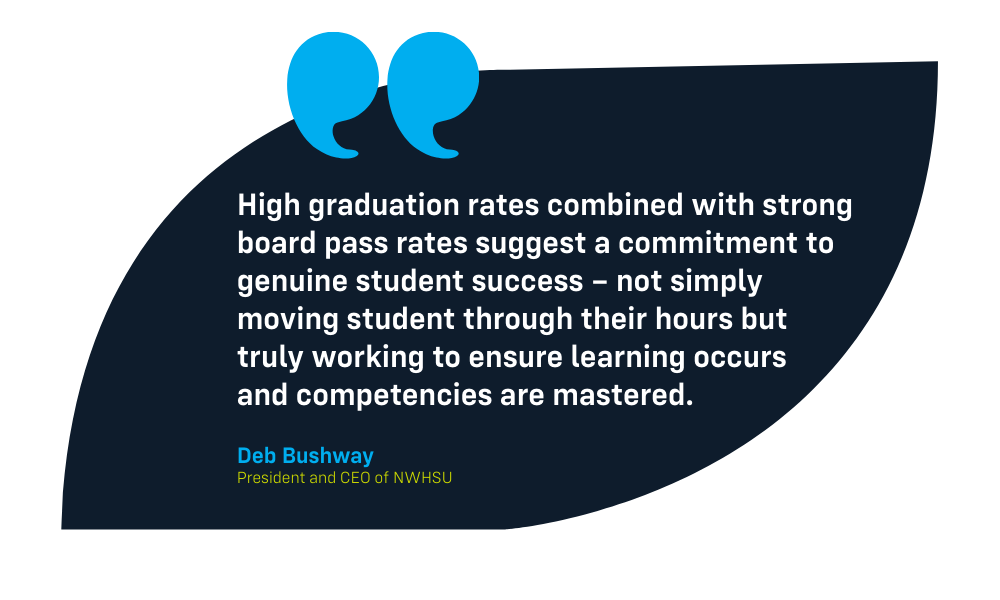
High graduation rates are part of program effectiveness. Evaluating graduation rates alongside other factors can provide a more complete picture of a school’s environment and its ability to support students through program completion.
Graduation rates can also reflect the level of student support provided by the university. Schools with strong academic advising, tutoring services, mental health resources and a strong sense of community often boast higher graduation rates. Understanding these aspects of a school’s support system can inform your decision and help ensure that you choose an institution where you can thrive.
Beyond the Numbers: How to Choose the Top Chiropractic School that’s Right for You
Of course, numbers can’t give you the whole picture: you’re going to spend three years of your life in chiropractic school. You want to understand what your day-to-day experience will be like, in and outside the classroom. And we’ll dive into those below.
Going beyond the numbers, examining the clinical education, curriculum, and learning community will help you picture yourself at chiropractic school, and ultimately make the decision that’s right for you.
Evidence-Informed vs. Philosophy-Based Curriculum
Chiropractic curricula can be placed on a continuum with one end of that spectrum consisting of purely philosophy-based education and the other end of the continuum being largely evidence-informed. All chiropractic schools or programs fall somewhere on the this continuum. All four top chiropractic schools, including Northwestern Health Sciences University, embrace evidence-informed practice, without erasing chiropractic’s roots and history.
This means that care is guided by the best available scientific evidence, combined with clinical expertise and patient values. It’s no wonder that this approach prepares you well for boards, but also for working more collaboratively with other healthcare professionals.
The Importance of Confidence & Applied Learning
So, if all four schools have evidence-informed curriculum, how do you distinguish between them? Northwestern Health Sciences University is the only school in the country to offer a competency-centered curriculum: turning the traditional passive and siloed learning model on its head. This curriculum eliminates the questions “Why am I learning this?” and “Will I use this info in the future with my patients?” It also means less time sitting in auditoriums, passively listening to lectures.
At NWHSU, you’ll need to demonstrate mastery of key skills and techniques to move forward. Throughout the trimester, in-person assessments will take place in a mock-clinical environment. When something isn’t clicking for you, we’ll catch it early and support you in getting where you need to be. 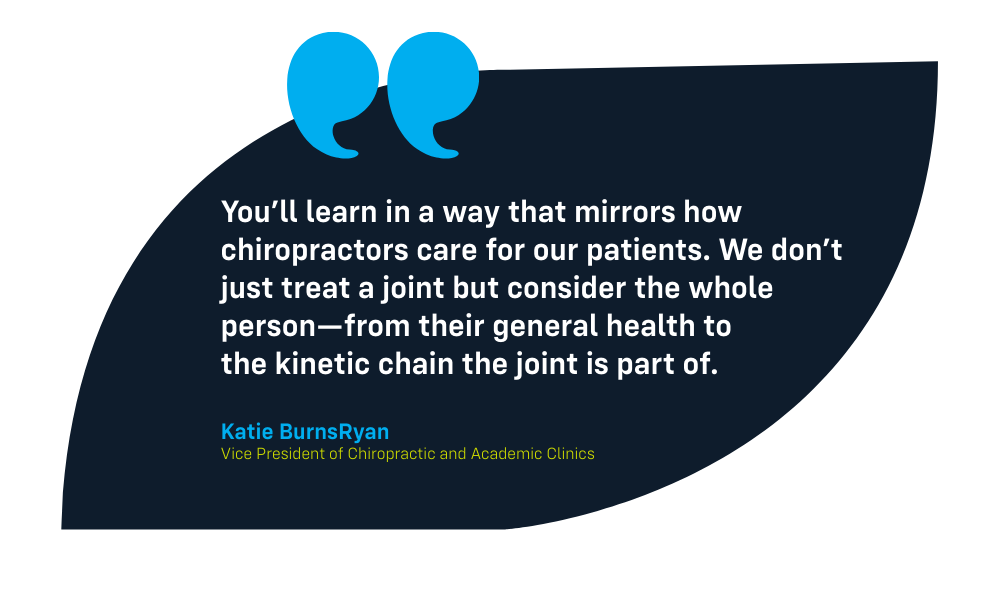
Our curriculum is designed for you to graduate feeling confident in your knowledge and skills. We want you to think like a Doctor of Chiropractic from day one as your patients will rely on you for guidance and expertise no matter where you practice.